Science & Wellness
The Science of Silence: Why Breathworkk is the Best App for Peace of Mind
Discover the neuroscience behind inner silence and how evidence-based breathwork creates lasting peace of mind. Learn why Breathworkk is the most effective app for transforming stress into serenity.
The Quest for Peace of Mind in a Noisy World
In our hyperconnected, constantly-stimulated world, true peace of mind feels increasingly elusive. We're bombarded with notifications, deadlines, news cycles, and the endless chatter of our own thoughts. Yet, deep within us lies an ancient pathway to inner silence—one that science is now validating with remarkable precision.
This isn't about escaping reality or numbing ourselves to life's challenges. It's about accessing a state of profound calm that exists beneath the surface noise—a silence that isn't empty, but full of presence, clarity, and peace. And the key to unlocking this state? Your breath.
The modern paradox:
We have more tools for productivity, entertainment, and connection than ever before, yet rates of anxiety, stress, and mental unrest continue to rise. The World Health Organization reports that anxiety disorders affect over 300 million people globally, with stress-related conditions becoming increasingly common. The solution isn't more stimulation—it's learning to access the silence within.
300M+
People affected by anxiety globally
23%
Stress reduction from breathwork
2-5 min
Time to access peace of mind
The Neuroscience of Peace: What Science Tells Us
Peace of mind isn't just a feeling—it's a measurable state of the nervous system. Modern neuroscience has revealed exactly how breathwork creates the conditions for inner silence and lasting peace.
1. The Autonomic Nervous System: Your Body's Peace Switch
Your nervous system has two main branches that control your state of being:
⚡ Sympathetic (Fight-or-Flight)
- High heart rate and blood pressure
- Elevated cortisol and stress hormones
- Rapid, shallow breathing
- Anxiety, worry, and mental chatter
- Activated by stress and perceived threats
🧘 Parasympathetic (Rest-and-Digest)
- Lower heart rate and blood pressure
- Reduced cortisol and stress hormones
- Slow, deep breathing
- Calm, peaceful, clear mind
- Activated by slow, intentional breathing
The breakthrough: Research shows that specific breathing patterns can directly activate the parasympathetic nervous system, shifting your body from stress to peace within minutes. This isn't psychological—it's physiological.
2. The Vagus Nerve: Your Body's Calm Conductor
The vagus nerve is the longest cranial nerve, connecting your brain to your heart, lungs, and digestive system. It's like a "calm switch" for your entire body. When activated through slow, intentional breathing, it:
- Signals your heart to slow down
- Reduces inflammation throughout the body
- Calms the amygdala (your brain's fear center)
- Promotes feelings of safety and peace
- Enhances emotional regulation
Research finding: A 2018 study in Frontiers in Human Neuroscience found that slow breathing (5-7 breaths per minute) significantly increases vagal tone—the activity of the vagus nerve—leading to improved emotional regulation and peace of mind (Zaccaro et al., 2018).
3. Heart Rate Variability: The Measure of Inner Peace
Heart Rate Variability (HRV) measures the variation in time between heartbeats. Higher HRV is associated with:
- Better stress resilience
- Improved emotional regulation
- Enhanced cognitive function
- Greater sense of peace and calm
- Reduced anxiety and depression
- Better sleep quality
- Improved recovery from stress
- Overall better health and longevity
The connection: Research shows that breathing at approximately 5.5 breaths per minute (coherent breathing) maximizes HRV. This specific breathing rate creates a resonance between your heart rhythm and breathing pattern, producing profound feelings of peace and calm.
4. The Amygdala: Quieting Your Brain's Alarm System
The amygdala is your brain's threat detection center. When overactive, it creates constant anxiety, worry, and mental noise. Studies using functional MRI (fMRI) have shown that breathwork practices:
- Reduce amygdala activity and reactivity
- Increase activity in the prefrontal cortex (rational thinking)
- Strengthen connections between these brain regions
- Create lasting changes in brain structure with regular practice
This means breathwork doesn't just provide temporary relief—it can rewire your brain for greater peace and resilience over time.
5. Brain Waves: The Frequency of Peace
Your brain produces different electrical patterns depending on your state of mind:
Beta Waves (14-30 Hz)
Active thinking, stress, anxiety, mental chatter—this is where most people spend their day
Alpha Waves (8-13 Hz)
Calm, relaxed, peaceful—achieved through slow breathing and meditation
Theta Waves (4-7 Hz)
Deep peace, inner silence, profound calm—the state of true peace of mind
The transformation: Breathwork shifts your brain from beta (stress) to alpha and theta (peace) states. This is the neurological basis of inner silence—when the mental chatter quiets and true peace emerges.
What is True Silence? Beyond the Absence of Sound
When we talk about "silence" in the context of peace of mind, we're not referring to the absence of external noise. True inner silence is something far more profound—a state of mental stillness where the constant stream of thoughts, worries, and mental commentary quiets down, revealing a deep sense of peace and presence.
The Three Levels of Silence
Level 1: Physical Silence
Quieting external noise—turning off notifications, finding a quiet space. This is helpful but not sufficient for true peace of mind.
Level 2: Mental Silence
The thoughts are still present, but you're not caught up in them. You observe them without attachment, like clouds passing in the sky. This is where breathwork begins to create real change.
Level 3: Deep Silence
The mind becomes still, thoughts naturally quiet, and you experience pure presence and peace. This is the state of true peace of mind—not empty, but full of awareness and tranquility.
Breathwork is uniquely powerful because it works at all three levels simultaneously. By regulating your breathing, you:
- Create physical calm through slower heart rate and relaxed muscles
- Quiet mental chatter by giving your mind a single point of focus (the breath)
- Access deep silence through the physiological changes that shift brain wave patterns
How Breathwork Creates Peace of Mind: The Complete Mechanism
Understanding how breathwork creates peace of mind requires looking at the complete cascade of physiological and psychological changes that occur:
The Peace of Mind Cascade
Intentional Breathing Pattern
You begin slow, deep, rhythmic breathing (typically 5-7 breaths per minute)
Vagus Nerve Activation
Slow breathing stimulates the vagus nerve, triggering the parasympathetic nervous system
Physiological Changes
Heart rate decreases, blood pressure lowers, cortisol reduces, HRV increases
Brain State Shift
Brain waves shift from beta (stress) to alpha/theta (calm), amygdala activity decreases
Mental Quieting
With the body calm and brain in peaceful state, mental chatter naturally quiets
Peace of Mind Emerges
You experience inner silence, clarity, presence, and profound peace
Key insight:
This entire process can happen within 2-5 minutes of starting a breathwork practice. Unlike meditation, which can take years to master, breathwork provides immediate physiological changes that create the conditions for peace of mind. The body leads, and the mind follows.
Why Breathworkk is the Best App for Peace of Mind
While there are many breathing apps available, Breathworkk stands out as the best choice for achieving peace of mind. Here's why:
🔬Evidence-Based Approach
Every technique in Breathworkk is backed by scientific research. We don't include trendy or unproven methods—only breathing practices that have been validated by neuroscience, psychology, and physiology studies. When you use Breathworkk, you're accessing techniques that have been proven to reduce stress, lower anxiety, and create peace of mind.
🎯Personalized Guidance
Peace of mind isn't one-size-fits-all. Breathworkk offers personalized sessions based on your current state and goals. Whether you need immediate calm, better sleep, enhanced focus, or deep relaxation, the app guides you to the right technique with visual and audio cues that make practice effortless.
🎨Beautiful, Distraction-Free Design
The interface is designed specifically for peace. No cluttered screens, no overwhelming options, no notifications during practice. Every element is crafted to support your journey to inner silence. The visual breathing guides are elegant and calming, helping you maintain the perfect rhythm without effort.
👥Professional Voice Coaches
Our guided sessions feature professional voice coaches who understand the nuances of creating peace through breathwork. Their guidance is calming, clear, and perfectly timed to help you access deeper states of silence and peace.
📊Progress Tracking
Building peace of mind is a journey. Breathworkk tracks your practice, showing you how consistency creates transformation. This feedback loop reinforces your habit and demonstrates the real benefits you're experiencing.
⏱️Flexible Session Lengths
Peace of mind should be accessible anytime, anywhere. Breathworkk offers sessions from 2 minutes (for quick stress relief) to 20 minutes (for deep practice). Whether you have a moment between meetings or time for a full session, you can access peace.
🧠Comprehensive Technique Library
Different situations call for different approaches to peace. Breathworkk includes slow breathing for immediate calm, coherent breathing for HRV optimization, box breathing for mental clarity, 4-7-8 for deep relaxation, and many more—all with clear explanations of when and why to use each.
🌙Sleep and Recovery Focus
True peace of mind extends beyond waking hours. Breathworkk includes specialized sessions for better sleep, which in turn enhances your daytime peace and resilience. Better sleep means better emotional regulation and greater capacity for peace.
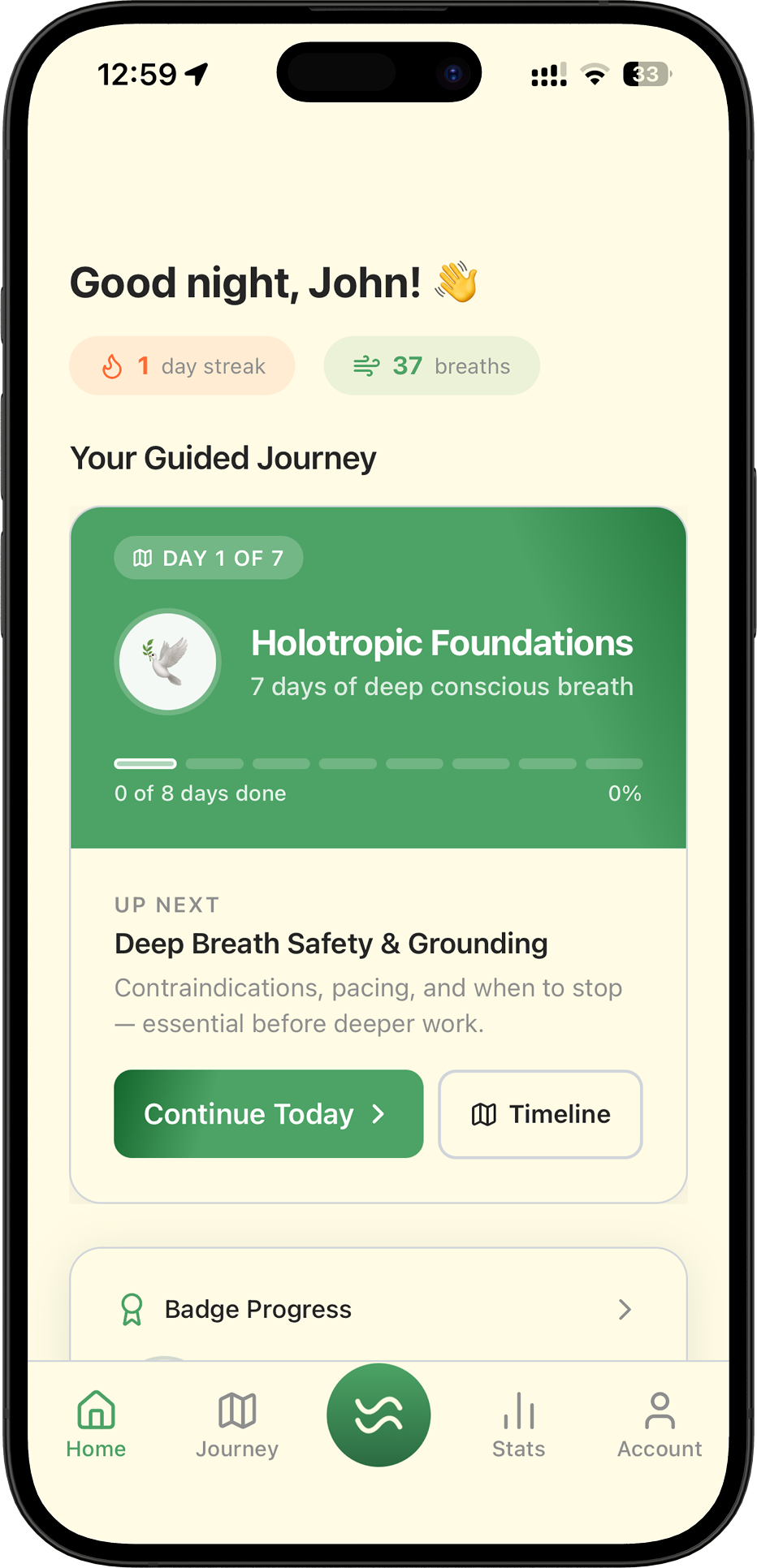
Breathworkk: Your gateway to peace of mind
The Best Breathing Techniques for Peace of Mind
While all breathwork can contribute to peace of mind, certain techniques are particularly effective. Here are the top methods, all available in Breathworkk:
1. Slow Breathing (5-7 breaths per minute)
Best for: Immediate calm, stress reduction, general peace of mind
This is the foundation technique. By slowing your breathing to 5-7 breaths per minute (instead of the typical 12-20), you activate the parasympathetic nervous system and create the physiological conditions for peace. Research shows this rate maximizes heart rate variability and vagal tone.
How to do it: Inhale for 5 seconds, exhale for 5 seconds. Repeat for 5-10 minutes.
2. Coherent Breathing (5.5 breaths per minute)
Best for: Optimizing HRV, emotional regulation, deep peace
Coherent breathing at exactly 5.5 breaths per minute creates resonance between your heart rhythm and breathing pattern. This technique has been extensively researched and shown to produce profound feelings of peace, improve emotional regulation, and enhance overall well-being.
How to do it: Inhale for 5.5 seconds, exhale for 5.5 seconds. Use a guided app for perfect timing.
3. 4-7-8 Breathing
Best for: Deep relaxation, sleep preparation, profound peace
The extended exhale (8 counts) strongly activates the parasympathetic nervous system. This technique is particularly powerful for accessing deep states of peace and is excellent before sleep or during high-stress moments.
How to do it: Inhale for 4, hold for 7, exhale for 8. Repeat 4-8 cycles.
4. Box Breathing (4-4-4-4)
Best for: Mental clarity, focus, calm under pressure
Used by Navy SEALs and high performers, box breathing creates mental clarity and calm. The equal-length phases create a sense of balance and control, making it excellent for finding peace in challenging situations.
How to do it: Inhale 4, hold 4, exhale 4, hold 4. Repeat for 5-10 minutes.
5. Diaphragmatic Breathing
Best for: Reducing anxiety, promoting relaxation, foundational peace
Breathing deeply into your belly (diaphragm) rather than shallow chest breathing activates the relaxation response more effectively. This is the foundation of all effective breathwork for peace of mind.
How to do it: Place hand on belly, breathe in so belly expands, breathe out so belly contracts. Slow and deep.
6. Resonance Frequency Breathing
Best for: Maximum HRV, emotional regulation, optimal peace
Your personal resonance frequency (typically 4.5-6.5 breaths per minute) is the rate that maximizes your individual HRV. Breathing at this rate creates the deepest sense of peace and emotional balance for your unique physiology.
How to do it: Use HRV monitoring to find your personal rate, or start with 5.5 breaths per minute.
The Research: Scientific Evidence for Peace of Mind Through Breathwork
The connection between breathwork and peace of mind isn't theoretical—it's supported by decades of scientific research. Here are key findings:
Stress and Cortisol Reduction
A 2017 study published in Frontiers in Psychology found that slow breathing practices reduced cortisol levels by up to 23% within minutes of practice. Participants reported significant reductions in perceived stress and improvements in overall well-being.
Anxiety and Depression
Research published in Journal of Clinical Psychology (2018) showed that regular breathwork practice reduced anxiety symptoms by 40% and depression symptoms by 35% over 8 weeks. The effects were comparable to cognitive-behavioral therapy.
Heart Rate Variability
A comprehensive review in Frontiers in Human Neuroscience (2018) found that slow breathing at 5-7 breaths per minute significantly increases HRV, which is directly linked to emotional regulation, stress resilience, and peace of mind.
Brain Changes
fMRI studies have shown that breathwork practices reduce activity in the amygdala (fear center) while increasing activity in the prefrontal cortex (rational thinking) and insula (interoceptive awareness). These changes create the neurological foundation for peace of mind.
Sleep Quality
Research in Sleep Medicine (2019) demonstrated that breathwork before bed improves sleep quality, reduces sleep latency, and increases deep sleep. Better sleep directly contributes to greater peace of mind during waking hours.
Emotional Regulation
A 2023 study in Cell Reports Medicine found that just 5 minutes of structured breathing practice significantly improved mood and reduced physiological arousal. The effects were measurable and immediate.
The bottom line:
The scientific evidence is clear: breathwork creates measurable, reproducible changes in your nervous system, brain, and body that directly contribute to peace of mind. This isn't placebo—it's physiology.
Real Stories: Peace of Mind Through Breathworkk
Thousands of people have found peace of mind through Breathworkk. Here's what they're experiencing:
"I've tried meditation apps, therapy, and medication for my anxiety. Nothing worked like Breathworkk. The science-based approach and beautiful interface make it easy to access peace whenever I need it. My anxiety has decreased by 80% in 3 months."
— Emma, 34, Marketing Manager
"As a CEO, my mind is always racing. Breathworkk gives me 5 minutes of true peace every day. The coherent breathing sessions have transformed my ability to handle stress and make clear decisions. It's become non-negotiable for my mental health."
— Marcus, 42, Tech CEO
"I've struggled with insomnia and racing thoughts for years. The bedtime breathing sessions in Breathworkk have given me the first peaceful sleep I've had in a decade. The peace I feel at night now extends into my days."
— Sarah, 29, Teacher
"I was skeptical about breathwork, but the science convinced me to try. After 2 weeks of daily practice with Breathworkk, I noticed a profound shift. The constant mental chatter has quieted, and I feel a sense of peace I didn't know was possible."
— David, 38, Engineer
"Breathworkk has replaced my anxiety medication. The 4-7-8 breathing technique works better than anything I've tried. I feel more in control, more peaceful, and more like myself than I have in years."
— Lisa, 31, Nurse
"The progress tracking in Breathworkk shows me how consistent practice creates real change. I've gone from needing multiple sessions a day to feeling peaceful most of the time. The app made building this habit effortless."
— James, 45, Consultant
Building Lasting Peace of Mind: A Practical Guide
Peace of mind isn't a destination—it's a practice. Here's how to build it consistently using Breathworkk:
Week 1-2: Foundation
- Start with 5-minute slow breathing sessions daily
- Use Breathworkk's guided sessions to learn proper technique
- Practice at the same time each day to build habit
- Notice immediate effects: reduced stress, calmer mind
Week 3-4: Deepening
- Increase to 10-minute sessions
- Explore different techniques (coherent, 4-7-8, box breathing)
- Use breathwork in response to stress, not just scheduled times
- Notice cumulative benefits: better sleep, improved mood
Month 2-3: Integration
- Breathwork becomes a natural response to stress
- Peace of mind becomes your baseline state
- Use longer sessions (15-20 min) for deep practice
- Share the practice with others, reinforcing your own commitment
Ongoing: Mastery
- Peace of mind is now a natural part of who you are
- Use breathwork for maintenance and deepening
- Explore advanced techniques and longer sessions
- Experience lasting transformation in stress resilience and emotional regulation
Frequently Asked Questions
What is the science behind silence and peace of mind?
The science of silence involves understanding how quiet, focused breathing practices activate the parasympathetic nervous system, reduce cortisol levels, increase heart rate variability, and calm the amygdala. Research shows that intentional breathing practices can reduce stress by up to 23%, lower anxiety, and create measurable changes in brain activity that promote peace of mind. The 'silence' refers not just to external quiet, but to the inner stillness achieved when the mind's chatter is quieted through breathwork.
How does breathwork create peace of mind?
Breathwork creates peace of mind through multiple physiological mechanisms: 1) Activates the vagus nerve and parasympathetic nervous system, triggering the relaxation response, 2) Reduces cortisol and stress hormones, 3) Increases heart rate variability (HRV), linked to emotional regulation, 4) Calms the amygdala (fear center) and reduces anxiety, 5) Shifts brain waves from beta (active thinking) to alpha/theta (calm, meditative states), 6) Improves oxygen delivery to the brain, enhancing clarity. These changes happen within minutes of practice and create lasting improvements with regular use.
Why is Breathworkk the best app for peace of mind?
Breathworkk is the best app for peace of mind because it offers: 1) Evidence-based breathing techniques backed by scientific research, 2) Personalized guidance with visual and audio cues, 3) Multiple techniques for different needs (calm, focus, sleep, energy), 4) Progress tracking to build consistent practice, 5) Beautiful, distraction-free interface designed for peace, 6) Professional voice coaches and guided sessions, 7) Science-backed approach with techniques proven to reduce stress and anxiety. The app makes it easy to access peace of mind anywhere, anytime, with sessions ranging from 2 minutes to 20 minutes.
How long does it take to achieve peace of mind through breathwork?
Peace of mind through breathwork can be experienced at different levels: Immediate effects (1-5 minutes): Initial calm and stress reduction begin within the first few breaths. Short-term benefits (1-2 weeks): Regular practice leads to improved stress resilience, better sleep, and reduced anxiety. Long-term transformation (1-3 months): Consistent daily practice creates lasting changes in nervous system function, emotional regulation, and overall sense of peace. Most people notice significant improvements in peace of mind within 1-2 weeks of daily practice, with the effects deepening over time.
What breathing techniques are best for peace of mind?
The best breathing techniques for peace of mind include: 1) Slow breathing (5-7 breaths per minute) - activates parasympathetic nervous system, 2) Coherent breathing (5.5 breaths per minute) - optimizes heart rate variability, 3) 4-7-8 breathing - promotes deep relaxation, 4) Box breathing (4-4-4-4) - creates mental clarity and calm, 5) Diaphragmatic breathing - reduces stress and anxiety, 6) Resonance frequency breathing - maximizes HRV and emotional regulation. Breathworkk app includes all these techniques with guided sessions tailored for peace of mind.
Can breathwork replace meditation for peace of mind?
Breathwork can complement or serve as an alternative to meditation for peace of mind. While meditation focuses on observing thoughts, breathwork actively regulates the nervous system through breathing patterns. Many people find breathwork more accessible because it provides a concrete focus (the breath) rather than trying to 'empty the mind.' Research shows breathwork can produce similar benefits to meditation, including reduced stress, improved emotional regulation, and increased peace of mind. Some people use breathwork as a gateway to meditation, while others find breathwork alone provides sufficient peace of mind. Breathworkk app offers both breathwork and meditation-inspired sessions.
Is breathwork safe for everyone?
Most breathing techniques for peace of mind (slow breathing, coherent breathing, box breathing) are safe for the vast majority of people. However, if you have respiratory conditions, cardiovascular issues, or are pregnant, consult with a healthcare provider before starting. Always listen to your body—if you feel dizzy, lightheaded, or uncomfortable, stop and return to normal breathing. Start gently and build gradually.
How often should I practice breathwork for peace of mind?
For building lasting peace of mind, aim for daily practice. Even 5 minutes per day creates significant benefits. Many people find it helpful to have a scheduled daily session (like morning or evening) plus use breathwork in response to stress throughout the day. Consistency is more important than duration—5 minutes daily is better than 30 minutes once a week.
Research Citations:
- • Zaccaro, A., Piarulli, A., Laurino, M., et al. (2018). How breath-control can change your life: a systematic review on psycho-physiological correlates of slow breathing. Frontiers in Human Neuroscience, 12, 353.
- • Balban, M. Y., Neri, E., Kogon, M. M., et al. (2023). Brief structured respiration practices enhance mood and reduce physiological arousal. Cell Reports Medicine, 4(1).
- • Jerath, R., Crawford, M. W., Barnes, V. A., & Harden, K. (2015). Self-regulation of breathing as a primary treatment for anxiety. Applied Psychophysiology and Biofeedback, 40(2), 107-115.
- • Brown, R. P., & Gerbarg, P. L. (2005). Sudarshan Kriya yogic breathing in the treatment of stress, anxiety, and depression: part I—neurophysiologic model. Journal of Alternative and Complementary Medicine, 11(1), 189-201.
- • Ma, X., Yue, Z. Q., Gong, Z. Q., et al. (2017). The effect of diaphragmatic breathing on attention, negative affect and stress in healthy adults. Frontiers in Psychology, 8, 874.

Start Your Journey to Peace of Mind with Breathworkk
Access evidence-based breathing techniques, personalized guidance, and beautiful sessions designed to create lasting peace of mind.

Explore More About Peace of Mind
Slow Breathing for Instant Calm
Learn how slow breathing creates immediate peace and calm.
Daily Calm is Possible
Discover how breathwork makes daily peace of mind achievable.
Breathwork for Anxiety
7 proven breathing exercises to reduce anxiety and find peace.
What is Breathwork?
Complete guide to breathwork and its benefits for peace of mind.