Breathwork Guidance
Guided Breathing Exercises for Daily Calm & Balance
Follow step-by-step breathing exercises with visual timers, audio cues, and real-time guidance. Perfect for beginners and experienced practitioners seeking consistent, effective breathwork practice.
What Are Guided Breathing Exercises?
Guided breathing exercises use visual cues, audio prompts, or timers to help you maintain proper breathing patterns without manually tracking time or counting. Instead of focusing mental energy on "Is this 5 seconds?" or "Did I hold long enough?", you simply follow the guidance—allowing deeper focus on the breath itself and maximizing physiological benefits.
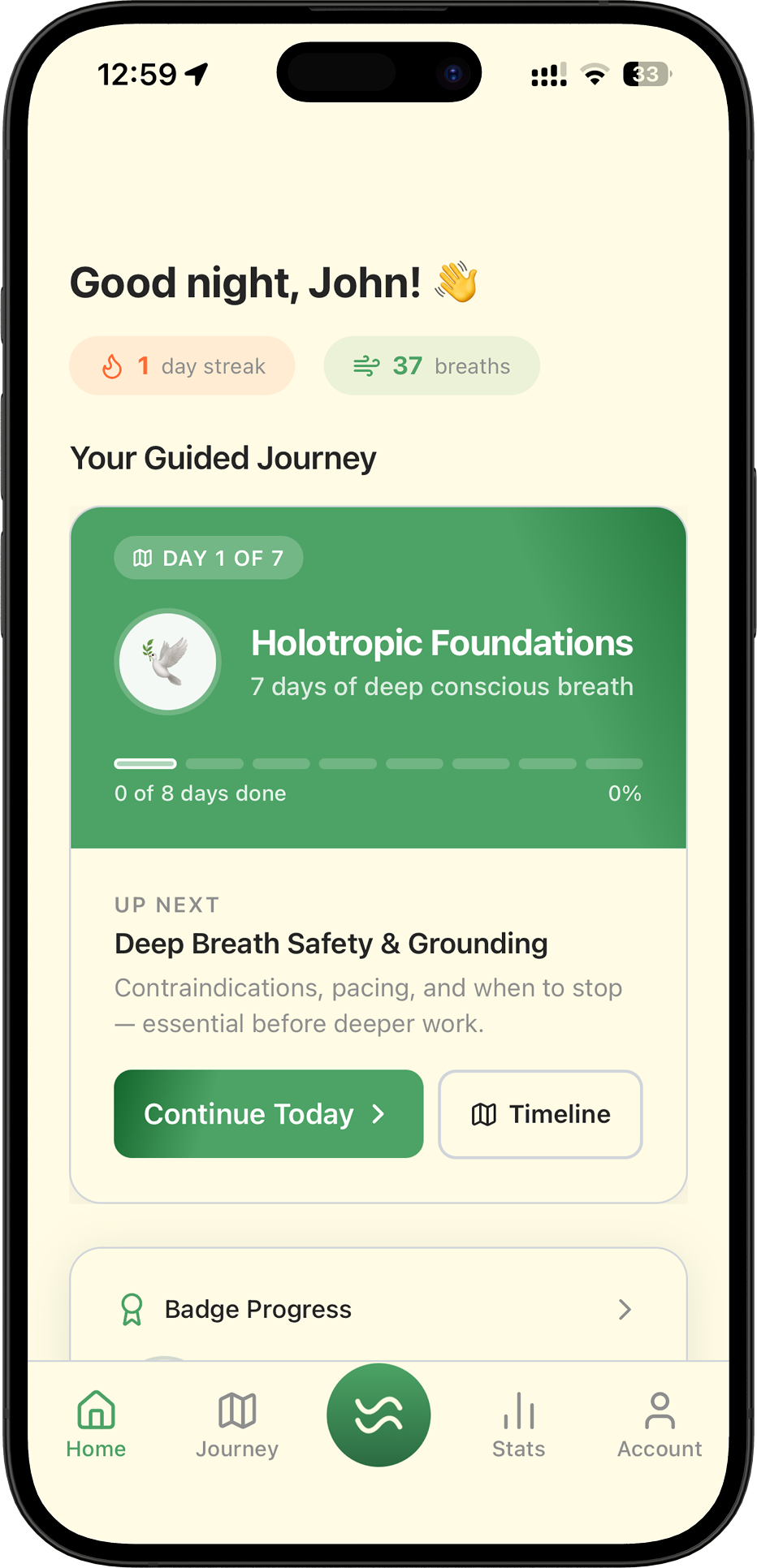
Visual breathing guides make it effortless to maintain perfect timing and rhythm
The Power of Guidance:
Studies show that guided breathing exercises are significantly more effective than unguided practice for beginners. Proper pacing is crucial for nervous system regulation—breathing too fast or uneven eliminates the benefits. Visual and audio guidance ensures optimal pacing every time, making breathwork accessible to everyone.
Why Use Guided Breathing Exercises?
Guided breathing offers distinct advantages over unguided practice, especially for beginners or during high-stress moments:
Perfect Timing, Every Time
Visual and audio cues ensure you maintain the optimal breathing pace for nervous system regulation. No counting, no guessing—just breathe with the guidance.
Easier to Sustain
External guidance helps you maintain practice for longer durations. Instead of mental effort on timing, you focus solely on breathing—making 10-20 minute sessions feel effortless.
Better for Beginners
Learning breathing techniques can be confusing. Guided exercises teach proper technique through experience, building muscle memory and confidence faster than written instructions alone.
Effective During Stress
When anxiety or stress is high, concentration suffers. Guided breathing provides an external anchor, preventing your mind from wandering to anxious thoughts and ensuring you complete the practice effectively.
Builds Consistency
Guided sessions make it easy to build a daily habit. You don't need to remember instructions or technique details— just open the app and follow along. This removes friction, increasing adherence to daily practice.
Tracks Progress
Guided breathwork apps often include session tracking, showing your practice history, total minutes, and consistency. This visibility motivates continued practice and celebrates your progress.
Types of Guided Breathing: Visual, Audio & Hybrid
Guided breathing exercises come in different formats. The best choice depends on your environment, goals, and personal preference:
Visual Guided Breathing
Uses expanding and contracting shapes, animated circles, progress bars, or countdown timers to show when to inhale and exhale.
Best For:
- • Office or public environments (silent)
- • Visual learners
- • Open-eye practice
- • Any time you can't use sound
Example Formats:
- • Expanding/contracting circles
- • Animated breath waves
- • Countdown timers with phase labels
- • Progress bars showing session completion
Audio Guided Breathing
Uses voice instructions, sound cues, tones, or music to guide your breathing rhythm and technique.
Best For:
- • Closed-eye practice
- • Meditation-style sessions
- • Auditory learners
- • Deep relaxation exercises
Example Formats:
- • Voice prompts ("inhale... exhale...")
- • Tone cues (higher pitch = inhale)
- • Background music with breathing rhythm
- • Guided meditation with breath focus
Hybrid Guidance (Visual + Audio)
Combines visual and audio cues for multi-sensory guidance, offering maximum support and engagement.
Best For:
- • Learning new techniques
- • Home practice
- • Maximum guidance and support
- • Building technique confidence
Advantages:
- • Reinforces timing through multiple senses
- • Reduces cognitive load
- • Easier for beginners to follow
- • Can adjust based on preference
Popular Guided Breathing Exercises
These techniques are most effective when practiced with guided visual or audio cues:
Box Breathing (4-4-4-4)
Inhale 4 sec → Hold 4 sec → Exhale 4 sec → Hold 4 sec
Perfect for focus, stress relief, and nervous system balance. The even 4-4-4-4 rhythm is easy to follow with visual guidance. Used by Navy SEALs, athletes, and professionals worldwide.
Coherent Breathing (5-5)
Inhale 5 sec → Exhale 5 sec (continuous, no pauses)
Breathe at your body's resonance frequency (5-6 breaths/minute) to maximize heart rate variability and nervous system regulation. Ideal for burnout recovery, stress resilience, and daily balance. Visual guidance makes the 5-5 rhythm effortless.
4-7-8 Breathing
Inhale 4 sec → Hold 7 sec → Exhale 8 sec
Dr. Andrew Weil's "natural tranquilizer" technique. The extended exhale strongly activates parasympathetic response. Perfect for sleep preparation, deep relaxation, and anxiety relief. Visual timers make the different durations easy to follow.
4-6 Breathing (Extended Exhale)
Inhale 4 sec → Exhale 6 sec
Simple yet powerful. The longer exhale activates calm response without complexity. Great for beginners, public practice, and quick stress relief. Visual guides make maintaining the exhale extension natural.
Triangle Breathing (4-4-4)
Inhale 4 sec → Hold 4 sec → Exhale 4 sec (no bottom hold)
Similar to box breathing but without the bottom hold, creating a smooth continuous flow. Easier for people who find breath retention challenging. Visual triangle animation makes the pattern intuitive.
How to Use Guided Breathing Exercises
Getting started with guided breathing is simple. Follow these steps for effective practice:
- Choose Your Goal: Select a technique based on what you need—focus (box breathing), balance (coherent breathing), relaxation (4-7-8), or quick calm (4-6).
- Find a Comfortable Position: Sit upright in a chair, lie down, or practice at your desk. Keep your posture relaxed but alert.
- Open Your Breathwork App: Launch a guided breathing app like Breathworkk and select your desired technique and duration.
- Start the Guided Session: Press start and follow the visual or audio cues. For visual guidance, watch the expanding circle—breathe in as it grows, out as it shrinks. For audio, follow voice prompts or tone cues.
- Breathe Through Your Nose: Unless instructed otherwise, inhale and exhale through your nose. Nasal breathing optimizes nervous system benefits.
- Let the Guidance Handle Timing: Don't mentally count or track time. Trust the visual or audio cues—this frees your mind to focus purely on the breath sensation.
- Notice Without Judgment: If your mind wanders, gently return attention to the guidance and your breath. This is normal and expected.
- Complete the Session: Continue until your timer ends. Most immediate benefits occur after 3-5 minutes, with deeper effects from 10+ minute sessions.
Pro Tip for Beginners:
Start with 3-5 minute sessions using visual guidance. Box breathing or 4-6 breathing are ideal first techniques. Once comfortable with shorter sessions, gradually increase to 10 minutes. Consistency matters more than duration—daily 5-minute guided sessions produce better results than occasional 30-minute sessions.
Building a Daily Guided Breathing Practice
Consistency is the key to long-term benefits. Here's how to integrate guided breathing into your daily routine:
Beginner Schedule (Week 1-2)
Goal: Build the habit with minimal friction
- • Morning: 5 minutes of guided box breathing or coherent breathing upon waking
- • Technique: Use visual guidance, same technique daily
- • Focus: Just showing up consistently, perfect technique comes later
Intermediate Schedule (Week 3-4)
Goal: Increase duration and add situational practice
- • Morning: 10 minutes of guided coherent breathing
- • Midday: 3-5 minutes of guided box breathing during lunch or a work break
- • Evening (optional): 5-8 minutes of guided 4-7-8 breathing before bed
- • As needed: 3-minute guided sessions before stressful events
Advanced Schedule (Week 5+)
Goal: Optimize for your specific needs and goals
- • Morning: 15-20 minutes of guided coherent breathing (nervous system training)
- • Midday: 5 minutes of guided box breathing (focus and stress reset)
- • Evening: 10 minutes of guided 4-7-8 or coherent breathing (wind-down)
- • Strategic use: 3-5 minute guided sessions before meetings, presentations, or high-stress situations
- • Experiment: Try different techniques for different situations
The Minimum Effective Practice:
If you can only commit to one session daily, make it 5-10 minutes of guided coherent breathing in the morning. This single practice, done consistently, provides the highest return on investment for nervous system health, stress resilience, and emotional regulation. Everything else is bonus.
When to Use Each Guided Breathing Exercise
Before Important Events
Meetings, presentations, difficult conversations
Use: 3-5 min guided box breathing for focus and calm alertness
During Anxiety or Stress
Feeling overwhelmed, anxious, or panicked
Use: 3-5 min guided 4-6 breathing or box breathing for immediate nervous system calming
Daily Wellness Practice
Building long-term stress resilience
Use: 10-20 min guided coherent breathing daily for HRV improvement and nervous system training
Before Sleep
Trouble falling asleep, racing thoughts
Use: 5-10 min guided 4-7-8 breathing with audio cues (eyes closed) for deep relaxation
At the Office
Need stress relief but in public/work setting
Use: 3-5 min guided box breathing or 4-6 breathing with silent visual cues at your desk
Learning New Techniques
Building confidence with breathwork
Use: Hybrid guided sessions (visual + audio) to learn proper pacing and technique

Practice Guided Breathing with Breathworkk
Beautiful visual guides, flexible session lengths, and multiple proven techniques—all designed for effortless daily practice.
Visual Breathing Guides
Smooth, expanding circles that make timing effortless
Multiple Techniques
Box, coherent, 4-7-8, and more—all guided
Flexible Durations
3, 5, 10, or 20-minute guided sessions

Frequently Asked Questions
What are guided breathing exercises?
Guided breathing exercises are structured breathing techniques that use visual cues, audio guidance, timers, or verbal instructions to help you maintain proper breathing patterns. Unlike unguided practice where you must track timing and technique yourself, guided exercises provide real-time support through expanding circles, countdown timers, sound cues, or voice prompts. This makes breathing exercises easier to follow, especially for beginners or during stressful moments when concentration is difficult.
Are guided breathing exercises better than doing them on your own?
Guided breathing exercises offer several advantages, especially for beginners. Visual and audio cues help you maintain proper pacing without mentally tracking time, allowing deeper focus on the breath itself. Guidance ensures correct technique, which maximizes physiological benefits like nervous system regulation. Many people find guided exercises easier to sustain for longer durations and more effective during high-stress moments. However, both guided and unguided practice are valuable—guidance excels for learning and consistency, while unguided practice builds independence.
What's the difference between visual and audio guided breathing?
Visual guided breathing uses expanding/contracting circles, animated graphics, or timers to show you when to inhale and exhale. This is ideal for silent practice, office environments, or people who prefer visual focus. Audio guided breathing uses sound cues, tones, or voice instructions to guide your breath. This works well with closed eyes, during meditation, or when you can't look at a screen. Many apps like Breathworkk offer both options, allowing you to choose what works best for your environment and preference.
How long should I practice guided breathing exercises?
For immediate stress relief or nervous system regulation, 3-5 minutes of guided breathing is effective. For daily wellness practice, 5-10 minutes provides optimal benefits. Beginners should start with 3-5 minute sessions to build the habit without overwhelm. More experienced practitioners often practice 10-20 minutes for deeper nervous system training. The key is consistency—daily 5-minute guided sessions are more beneficial than occasional 30-minute sessions.
Can guided breathing exercises help with anxiety and stress?
Yes, guided breathing exercises are highly effective for anxiety and stress relief. Research shows that slow, controlled breathing activates the parasympathetic nervous system, reducing cortisol, lowering heart rate, and calming the amygdala (the brain's fear center). Guided exercises are particularly helpful during anxiety because the external guidance prevents your mind from wandering to anxious thoughts. Techniques like box breathing, coherent breathing, and 4-7-8 breathing—when properly guided—can reduce anxiety symptoms within 3-5 minutes.
What are the best guided breathing exercises for beginners?
Beginners should start with simple, rhythmic techniques: 1) Box Breathing (4-4-4-4) provides an even, predictable rhythm that's easy to follow with visual guidance. 2) Coherent Breathing (5-5) is gentle and builds nervous system resilience. 3) 4-6 Breathing (inhale 4, exhale 6) emphasizes longer exhales for calm. These techniques are simple enough for beginners yet effective for all experience levels. Using a guided breathwork app with visual cues makes learning these patterns effortless.
Can I use guided breathing exercises at work or in public?
Absolutely. Guided breathing exercises with visual cues (no sound) are perfect for office environments, public transit, or anywhere you need discreet stress relief. You can practice at your desk using a breathwork app on your phone or computer. Most techniques require no special position—just normal breathing through your nose while following the visual guide. This makes guided breathing one of the most accessible stress management tools for busy professionals. Learn more:Breathwork for Business Professionals.
Related Breathwork Resources
Breathwork App for Beginners
Start your breathwork journey with simple, guided techniques.
Breathing Exercises for Anxiety
Proven techniques to calm anxiety in 3-5 minutes.
Breathwork for Focus
Enhance concentration and mental clarity with targeted breathing.
Breathwork for Sleep
Guided breathing exercises to help you fall asleep faster.
4-7-8 Breathing Technique
Master the natural tranquilizer technique with guided practice.
Box Breathing vs Diaphragmatic Breathing
Compare popular techniques and learn when to use each.
Science of Breathwork
Discover the research-backed benefits of breathing exercises.
Coherent Breathing for Burnout
Use guided coherent breathing for nervous system reset and burnout recovery.