Consciousness & Experience
How to "Get High" on Your Own Supply (Oxygen, That Is)
Discover the fascinating science and practice of achieving natural altered states, euphoria, and profound experiences through nothing but your breath—no substances required.
The natural high: getting high on your own supply
You have the most powerful psychoactive substance on Earth already inside you—oxygen. Through specific breathing techniques, you can trigger profound altered states of consciousness, euphoria, emotional release, and transformative experiences that rival any external substance.
This isn't pseudoscience or New Age mysticism. It's a documented phenomenon backed by neuroscience, used for centuries in spiritual traditions, and increasingly studied by researchers. From Wim Hof's method to holotropic breathwork, people worldwide are discovering they can access extraordinary states of consciousness through nothing but controlled breathing.
Why this matters:
Unlike external substances, breathwork-induced states are completely natural, legal, free, and under your control. You're not introducing foreign chemicals—you're using your own physiology to access expanded states of consciousness that already exist within you.
The science: how breathing creates altered states
When you breathe in specific patterns—particularly rapid, deep breathing followed by breath retention—you trigger a cascade of physiological and neurochemical changes:
1. Oxygen supersaturation
Rapid breathing floods your blood with oxygen, increasing O2 saturation from normal 95-98% to near 100%. This hyperoxia affects brain function and can produce tingling sensations and altered perception.
2. CO2 depletion (hypocapnia)
Rapid breathing expels CO2 faster than your body produces it, creating a temporary state of hypocapnia. This changes blood pH (respiratory alkalosis), affects cerebral blood flow, and alters consciousness. It's a key mechanism behind breathwork-induced states.
3. Endorphin and DMT release
Intense breathwork triggers the release of endorphins (natural opioids) and potentially endogenous DMT, creating euphoria and altered perception. Research shows breathwork can increase endorphin levels significantly.
4. Adrenaline surge
Controlled hyperventilation activates the sympathetic nervous system, releasing adrenaline and noradrenaline. Studies show breathwork can increase adrenaline by 200-300%, creating intense alertness and energy.
5. Brainwave changes
Breathwork shifts brain activity from beta (normal waking) to alpha and theta waves (associated with meditation, creativity, and altered states). EEG studies show increased theta activity during holotropic breathwork sessions.
6. Default Mode Network (DMN) suppression
Like psychedelics, intense breathwork can temporarily suppress the DMN—the brain network associated with self-referential thinking and ego. This creates feelings of ego dissolution, unity, and expanded consciousness.
Research insight:
A 2022 study published in Frontiers in Psychology found that holotropic breathwork produces experiences phenomenologically similar to psychedelics, including ego dissolution, mystical experiences, and lasting positive changes in well-being—all through breathing alone.
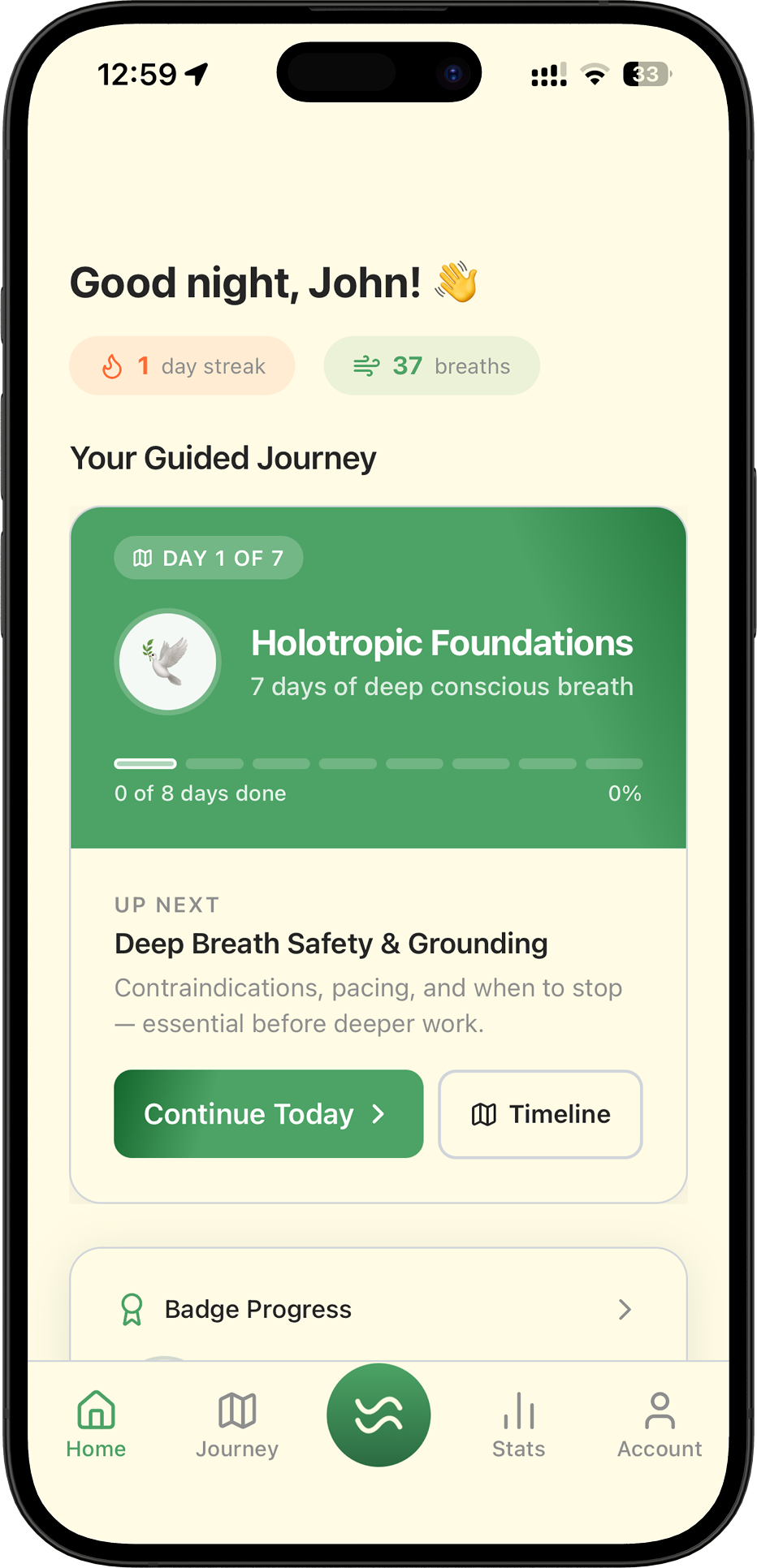
Guided breathwork sessions for expanded states
What does it feel like? The breathwork experience
The "breathwork high" varies widely between individuals and sessions, but common experiences include:
Physical sensations
- Tingling in hands, feet, face (paresthesia)
- Warmth or energy flowing through body
- Muscle tension or tetany (temporary)
- Lightheadedness or floating sensation
- Vibrations throughout the body
Emotional experiences
- Euphoria and bliss
- Emotional release (crying, laughing)
- Processing of past trauma
- Deep peace and contentment
- Love and connection
Mental/cognitive effects
- Altered time perception
- Profound insights and realizations
- Enhanced creativity
- Mental clarity and focus
- Dissolution of mental chatter
Spiritual/transcendent experiences
- Ego dissolution
- Unity consciousness
- Mystical or spiritual experiences
- Visual imagery or visions
- Sense of connection to something greater
"The first time I did Wim Hof breathing, I couldn't believe what I was experiencing. Intense tingling, then this wave of euphoria, then I started crying—releasing emotions I didn't even know I was holding. It was more profound than anything I'd experienced, and it was just my breath."
— Alex, 32, first-time breathwork experience
Techniques: how to get high on oxygen
Here are the most effective techniques for accessing altered states through breathwork. Always practice sitting or lying down in a safe environment.
1. Wim Hof Method (Beginner-Friendly)
The most accessible technique for experiencing altered states. Combines controlled hyperventilation with breath retention.
How to practice:
- Sit or lie down comfortably
- Take 30-40 deep, full breaths (inhale fully through nose or mouth, exhale naturally)
- After the last exhale, hold your breath as long as comfortable
- When you need to breathe, inhale deeply and hold for 15 seconds
- Repeat for 3-4 rounds
- Total time: 15-20 minutes
✨ Experience level: Moderate to strong altered state
2. Holotropic Breathwork (Advanced)
Developed by Stanislav Grof, this technique can produce profound, psychedelic-like experiences. Traditionally done with a facilitator.
How to practice:
- Lie down in a safe, comfortable space
- Breathe rapidly and deeply through the mouth
- Maintain the rhythm continuously for 30-60 minutes
- Focus on the breath and allow whatever arises
- Have music playing (often evocative or shamanic)
- Best done with an experienced facilitator initially
✨ Experience level: Very strong, potentially psychedelic-like
3. Transformational Breath (Intermediate)
A connected breathing pattern that creates altered states while maintaining more conscious control.
How to practice:
- Lie down comfortably
- Breathe in a connected pattern: inhale-inhale-exhale (no pauses)
- Breathe fully into the belly, then chest
- Maintain rhythm for 20-30 minutes
- Focus on expanding the breath and releasing tension
✨ Experience level: Moderate altered state with emotional release
4. Breath of Fire Extended (Intermediate)
Extended practice of this Kundalini technique can produce euphoric states and energy surges.
How to practice:
- Sit with straight spine
- Breathe rapidly through nose (2-3 breaths per second)
- Equal emphasis on inhale and exhale
- Continue for 5-10 minutes (build up gradually)
- Rest and observe the effects
✨ Experience level: Moderate to strong energy and euphoria
5. The "Oxygen High" Protocol (Custom)
A sequence designed specifically for accessing euphoric states.
How to practice:
- Start with 5 minutes of Breath of Fire to activate energy
- Transition to 3 rounds of Wim Hof breathing
- Finish with 10 minutes of connected breathing (holotropic-style)
- Rest in stillness for 5-10 minutes after
- Total time: 30-40 minutes
✨ Experience level: Strong to very strong altered state
Safety and contraindications
While breathwork is generally safe, these techniques can produce intense experiences. Follow these guidelines:
⚠️ Critical safety rules:
- Always practice sitting or lying down (never standing, driving, or in water)
- Stop if you feel uncomfortable (severe dizziness, chest pain, extreme discomfort)
- Have a safe, quiet space where you won't be disturbed
- Start with shorter sessions and build up gradually
- Consider having a trusted person nearby for your first intense sessions
Do NOT practice intense breathwork if you have:
- Cardiovascular disease or high blood pressure
- Epilepsy or seizure disorders
- Severe mental illness (schizophrenia, bipolar disorder)
- Are pregnant
- Recent surgery or serious injury
- Severe asthma or respiratory conditions
Consult a healthcare provider if you have any medical conditions.
Normal vs. concerning experiences:
Normal (safe):
- Tingling in extremities
- Lightheadedness
- Emotional release
- Muscle tension
- Altered perception
- Euphoria
Stop if you experience:
- Severe chest pain
- Extreme dizziness or fainting
- Severe panic or terror
- Loss of consciousness
- Severe muscle cramping
- Difficulty breathing normally after
Integration: making sense of the experience
Intense breathwork experiences can be profound and sometimes overwhelming. Integration is key:
- Rest after practice: Give yourself 10-20 minutes of quiet time to integrate the experience.
- Journal: Write down insights, emotions, or experiences while they're fresh.
- Be gentle with yourself: Emotional releases are normal and healthy—allow them.
- Talk it through: Discuss profound experiences with trusted friends or a facilitator.
- Give it time: Understanding often comes days or weeks after the experience.

Experience guided transformational breathwork on Breathworkk
Safely explore altered states with professionally designed sessions, from beginner to advanced levels.

Frequently asked questions
Is this similar to hyperventilating from panic?
No. While both involve rapid breathing, panic hyperventilation is uncontrolled and fear-driven. Breathwork is intentional, controlled, and done in a safe, relaxed state. The physiological mechanisms overlap, but the context and intention create completely different experiences.
Can you become addicted to breathwork?
No, breathwork doesn't create physical dependency. Some people enjoy the experiences and practice regularly, but this is more like enjoying meditation or exercise rather than addiction. You're not introducing external substances that create dependency.
How does this compare to psychedelics?
Research shows holotropic breathwork can produce experiences phenomenologically similar to psychedelics, including ego dissolution and mystical experiences. However, breathwork is generally shorter, more controllable, and you can stop anytime. It's legal, free, and leaves no substances in your system.
Why do I feel tingling in my hands and face?
This is called paresthesia, caused by temporary changes in blood CO2 levels and pH. It's completely normal and harmless. The tingling typically subsides within minutes after returning to normal breathing.
Can everyone experience altered states through breathwork?
Most people can, but experiences vary widely. Some people have profound experiences their first time, others need several sessions. Factors include technique, duration, mindset, environment, and individual physiology. Consistency and proper technique increase the likelihood of strong experiences.
How often can I practice intense breathwork?
For intense sessions (holotropic, extended Wim Hof), 1-3 times per week is typical. Daily practice of shorter sessions (10-15 minutes) is fine. Listen to your body and give yourself time to integrate experiences.
Research Citations:
- • Rhinewine, J. P., & Williams, O. J. (2007). Holotropic breathwork: The potential role of a prolonged, voluntary hyperventilation procedure as an adjunct to psychotherapy. Journal of Alternative and Complementary Medicine, 13(7), 771-776.
- • Kox, M., van Eijk, L. T., Zwaag, J., et al. (2014). Voluntary activation of the sympathetic nervous system and attenuation of the innate immune response in humans. PNAS, 111(20), 7379-7384.
- • Pressman, S. D., et al. (2022). Holotropic breathwork produces experiences comparable to psychedelics. Frontiers in Psychology, 13.
- • Carhart-Harris, R. L., & Friston, K. J. (2019). REBUS and the anarchic brain: toward a unified model of the brain action of psychedelics. Pharmacological Reviews, 71(3), 316-344.